There are unassuming spots around the globe that get very little coverage. But the quiet, persistent work of discipleship carries on.
This month, we'll take you to two very different parts of the world. One, a mountain village where a small tribe is raising Christian leaders amid real danger. The other, a nation still nursing wounds from a war many of us only half-remember—but where broadcast media is bringing Christ to homes that have never known Him before.
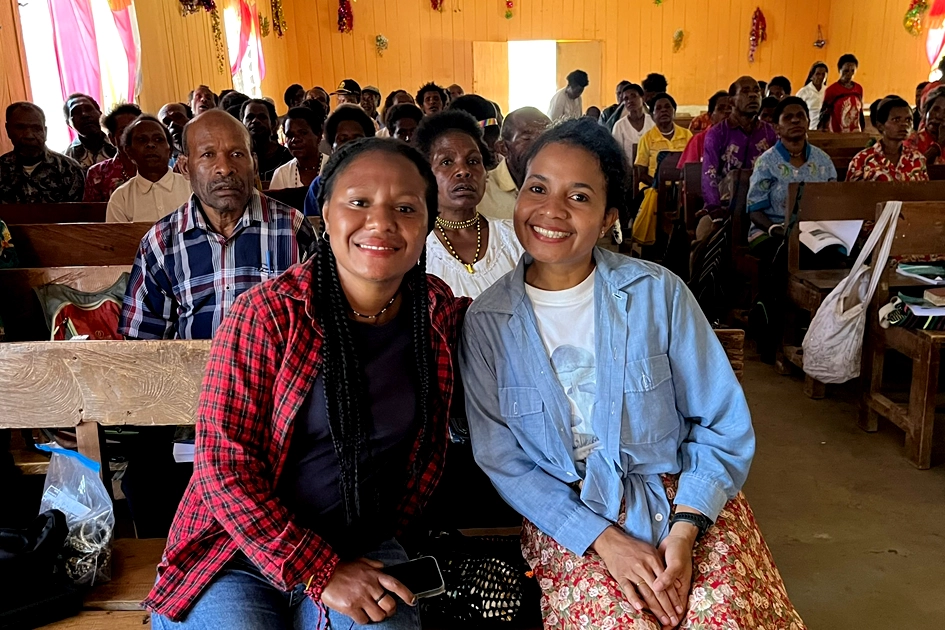 Photograph by Keith Crawford
Joy for Those Who Grieve
Leadership Principles for the Moni of West Papua
It was one of Joel Zaldumbide’s most draining and demanding trips, and an experience he won’t soon forget. Recently, Joel—one of In Touch’s key Life Principles trainers—logged 32 flight hours to offer training in the rugged mountainous region of West Papua, Indonesia.
Life Principles Training, a short discipleship seminar rooted in the teachings of Dr. Charles Stanley, is designed to equip ministry leaders worldwide with a firm biblical foundation.
In the region of Pogapa live the Moni, a Melanesian tribe unreached by the outside world until roughly 1937. Without conveniences like modern plumbing, they live much as they did centuries ago, subsisting on fruit, roots, and pigs. The tribe is also home to many devoted Christian men and women eager to grow in their faith.
While praying about where In Touch should take the Life Principles, Joel found himself thinking of someone he’d met years earlier, a man who grew up as a missionary kid among the Moni. When Joel reached out to John Cutts to offer leadership training, he heard crying on the other end of the line. “If it’s a bad time,” Joel said, “I can call back.” But it was the perfect time—the Moni were in a difficult situation, and Cutts wasn’t sure what to try next.
The difficulty was no small thing. The Moni are caught between Indonesian forces and armed rebels. Schools and medical facilities built in the region are at risk of attack by insurgents seeking to root out government influence. Worst of all, the rebels have kidnapped, assaulted, and sometimes killed the wives and daughters of Moni leaders—a tragedy that has weighed on the people for years.
Despite it all, 74 pastors and ministry leaders gathered for two days of teaching, translated from English into the Moni language. Participants also received a Messenger in the Moni and Indonesian languages. The training repeatedly required explanations for concepts that don’t exist in the culture—an experience that left Joel and his translator exhausted.
“How do you explain joy, ” Joel asked, “to a husband whose daughter was killed and whose wife was assaulted for a year? ” It's a question he still can't fully answer. But he saw the Moni sit with it—with the balm of God in one hand and their grief in the other.
A few weeks after his trip, as the Moni leaders gathered for the Lord’s Supper, they sent a greeting to Joel and the team at In Touch. With their thanks, they included encouragement from a pastor who’d nearly quit because of the challenges. After listening to the lessons from Dr. Stanley’s 30 Life Principles, this pastor decided to leave the consequences to God and renewed his call to ministry.
Joel doesn’t measure his ministry by results. “I am not the kind of person who pursues to see fruit,” Joel said. “Because that belongs to God, not to me.” But the fruit came anyway, just as God has promised (Isa. 55:11).
Locked Doors, Open Airwaves
Hope for a nation still healing from war
We move next to Southeastern Europe, where violence and conflict too often form the backdrop of stories. While the Moni people have grappled with persecution, residents of the former Yugoslavia live with lasting trauma from the war and ethnic cleansing of the 1990s. But people of God are present, and the church is growing.
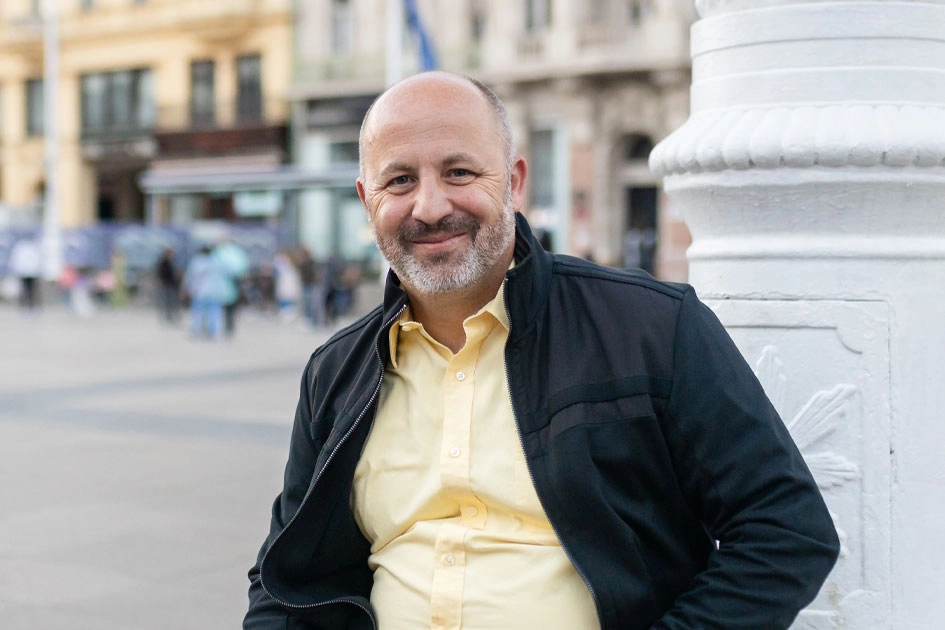 Photograph by Jonas Kako
Mario Časni lives in Croatia, where he directs media projects throughout Eurasia for Reach Beyond. I got to spend a little time with him on a recent trip through the Balkans.
John: Hi, Mario. Thank you for hosting us! Remind me about how long you’ve been partnering with us at In Touch.
Mario: I serve here in Croatia. In Touch has been part of our lives for the last five years. It’s made a great impact because Croatia really needs Christ. There aren’t very many believers here.
John: Tell me about your beautiful country. What’s Croatia like?
Mario: Croatia is a very small country—about 4 million people—located in South Central Europe. The count of evangelical believers is very small. We’re talking less than 1%, which accounts for about 4,000 believers. It is hard to reach all that population for Christ, even if the number is small.
John: How has In Touch Ministries helped you reach people across Croatia?
Mario: It’s very simple. People need God. And our job is to meet them where they’re the most tender and sensitive. A lot of the time, God uses the circumstances of their life with a particular message that speaks to them directly. I don’t believe in chance. When they hear a message, I believe it is a God-ordained moment for them.
Just this morning, I met a lady before church who’s a retired pharmacist. She told me, “There was some kind of preacher I was listening to, and he posed a question about changing life for good. And I wondered, what is a better time than now to do that?” I asked her, “Do you know the name of that preacher?” And it was Charles Stanley! But she was shy about coming to share her story with you. She’s part of the 55-plus generation who lived under Communism, and that meant you never stuck your head up. So if you do anything above you, you're going to be cut down immediately.
John: A lot of us who grew up in the States saw what was going on with the former Yugoslav states in the 1980s and ’90s. But I don’t think I’ve ever realized the kind of trauma that must have been created. Tell us a little bit about what went on.
Mario: I grew up in Yugoslavia, and I really can’t say that I had a huge amount of persecution based on my evangelical beliefs. Anybody who had religious beliefs was, in that sense, persecuted in the same way. They looked down on us. To me, that was the persecution. For example, my dad could not advance in his work because he was not part of the Communist Party. The main thing is that Communism is your religion.
What they did was, they closed the door of the church from the outside and said, You can have your meetings within your four walls. You cannot go outside, you cannot preach on the streets, you have no access to media, and you cannot spread literature. So, if you want to have your four-walls little sect thing, go for it. The church was imprisoned within the church building.
I remember as a teenager going to church and being escorted by a police officer. A police officer would always be in our church. He would stand by the door. We also had a neighbor living just across our street. As we walked to church, he would be at the window every Sunday and make a note of when. And he’d note when we came back. That was his duty, and we knew he was doing it.
John: When did that change?
Mario: Gradually, beginning in 1991. Then, in 1998, that was the first open-air evangelism event in Croatia. That was the first time Billy Graham was here, and he was speaking. It was an era when he was able to speak and hold an open rally. That was because he was such a globally known person.
John: Mario, you produce television content, providing programming for stations. Not Christian stations but secular ones, because they have a requirement to air a certain amount of religious content?
Mario: Well, television stations have a requirement to produce local content or to incorporate programming of local interest. We came into the picture as one of those providers because we knew what to produce and how to present it. It was our niche and our entry to get into programming. Now we’ve done that for more than 15 years.
John: And God prepared you for that. Your career was in media. What was that moment like when you began to rethink your calling?
Mario: My wife and I were thinking, Okay, we are living our regular Christian lives. But is that all God has called us to do? Is it just to sustain our life and make a living, or is there something more? Being in the media, I realized there are so few of us believers in Croatia, and our voices could be amplified by using the media. We can reach into homes and meet people where they are. And when they respond, we have a team of counselors who are very happy to talk with them. That can lead them to a local church and a local pastor who can disciple them.
John: So, your ministry goes far beyond getting programs into the area.
Mario: That’s the idea. It’s all about fellowship. I think that as the world recognizes us by the love we have for each other, the world is going to be convinced that there is a God who started all that. Today, we’re trying to show people that it is God who works through us to reach their hearts. And the point is, He loves them. Christ’s love can be very, very powerful.
Thanks for spending time with us on this update. We’re so glad you’re here. As you go on with the rest of your day, take a moment to reflect on the moment you’re in. What burdens are you carrying? It could be a painful past, or perhaps it’s a longing to see change. What door might God be opening that you never expected?