In my yard, I have a couple of walnut trees. Each year, they produce copious amounts of baseball-sized fruit that drops to the ground, often right behind me, with a startling wallop. It’s enough to make me consider wearing a helmet while outdoors. And though I haven’t yet suffered a direct hit, I was recently struck by the fruit—in another manner of speaking.
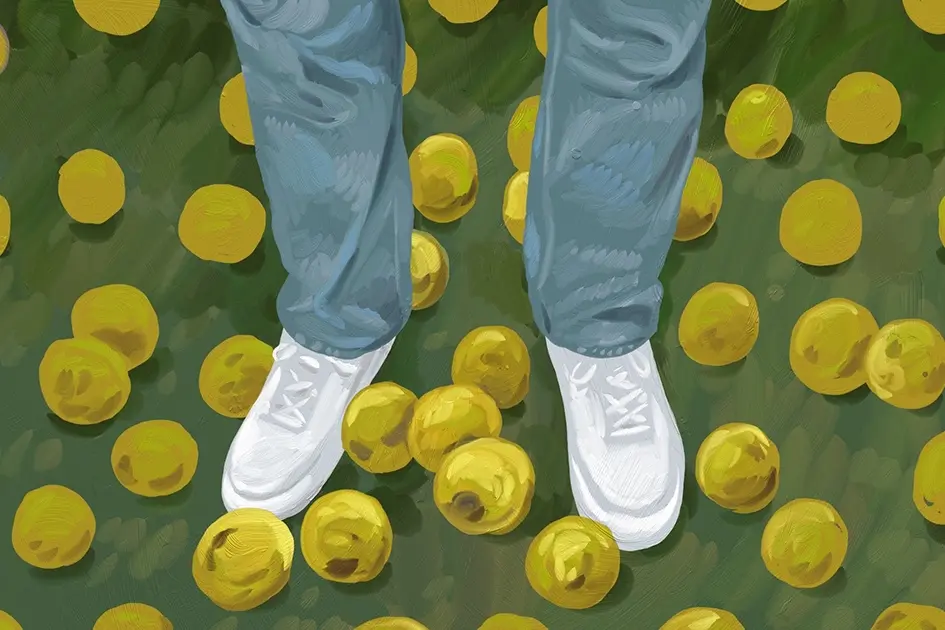 Illustration by Jeff Gregory
I was mowing the lawn one fall afternoon, my mind racing as fast as the whirring blades. A month or so prior, I’d left my job and was in the process of looking for work. Bank accounts were running low, and the pantry grew emptier by the day—despite the countless résumés I’d sent. I was, in a word, stressed.
As I pushed the mower under one of the trees, through a pile of nuts so dense it felt like mowing in a ball pit, I had the semi-consoling thought that if things didn’t turn around soon, at least we wouldn’t starve. It was as if one of those walnuts had smacked me in the head and reminded me of a truth I’d forgotten.
In our modern Western culture, nearly everything we have comes to us the same way: We buy it. Cut off our source of income, and suddenly the simplest things feel hard to come by. Understandably, money can seem like the cornerstone of the household. But the Bible contains direct warnings about it. Jesus tells us we can’t serve money and God (Matt. 6:24). Paul tells us the love of money is the root of “all sorts of evil” (1 Tim. 6:10). And James warns the church against favoring someone just because he or she is wealthy (James 2:2-4). Untangling our relationship with money is a much larger task than can be explored in a single article, but I can tell you this. As I was slogging through a pile of freshly fallen walnuts, I realized that money is like a cloud—seemingly solid but ultimately unable to support me.
My stress largely came from worry over provision. I was asking, more or less, Where will my help come from? But what I was really concerned about was where my next paycheck would come from. It’s a valid concern, sure, but I was approaching my situation from the wrong direction. I was so focused on one facet of God’s provision that I wasn’t seeing the much larger reality that He provides in superabundant ways. I was literally walking all over it.
Having a narrow view of provision is a sly little trap. Going all the way back to the beginning, we see that God placed Adam and Eve in a garden that provided everything. But we know how the story goes. They ate from the Tree of the Knowledge of Good and Evil, death entered the world, and God cursed the ground (Gen. 2:1-25; Gen. 3:1-24). The design of creation—for things to grow and produce fruit—remained unchanged. But now we endure painful labor, as well as thorns and thistles, to eat from creation’s yield. I think much of human progress is motivated by our striving to escape the curse. To make work easier. To eat without the toil. To live without worrying about our next meal.
Consider the arc of human progress. We learned to cultivate the cursed ground, then to trade what we grew, then to use currency to stand in for the trade itself. Each step was a reasonable, often ingenious response to the difficulty of survival. And none of it is inherently wrong. Whether we work the soil for a living or have never set foot on a farm, we're all navigating the same fallen world with the tools available to us.
But somewhere along the way, the distance between many of us and our food supply grew so vast that we’ve lost sight of what's really at stake in our reliance on the fruits of the earth. The farmer who watches a crop fail and the office worker who watches a bank account drain are feeling the same vulnerability—just from different angles. However, because farmers work directly with the soil, perhaps they have a more immediate understanding of where provision actually begins.
When things are normal, it seems as if we’re taken care of. A single grocery store holds vast quantities of food that would have been stupefying just a couple of generations ago. We have access to fruit in all seasons, even the dead of winter, as well as canned and frozen vegetables that will last for years. And how many grocery stores are there in just one town? All of this abundance is at our fingertips—if we have income to pay for it. But disrupt the flow of money, and scarcity rushes back in.
Creation is filled with provision that’s often taken for granted, even treated as a nuisance. (Consider the fact that some people will cut down a fruit-bearing tree just because of the mess it leaves on the sidewalk.) But distance from God’s tangible provision creates the conditions for distance from God Himself. If I’m looking to God only when I need a source of income, then perhaps money has actually become my god.
What, then, can we do? Abandon all the cities and become farmers again? That hardly seems practical. Anyway, it’s a heart issue more than one of practicality. I didn’t need to immediately give up my job search, start foraging, and survive off the land. What I needed was to remember that God is the sole source of all provision and to embrace the truth that He provides in unexpected ways—which requires a change of thinking on my part.
Money wants us to cling tightly to it—or at least to the idea of the steady life we think it buys—and to fear losing that security above all else. But what money provides is shockingly fragile. God, on the other hand, offers a life that is secure in any economic circumstance. Maybe it’s not always easy to rely on God for our daily bread, but doing so will always lead to something good and abundant and filled with hope.